Helper Functions
Functions for data I/O, masking and pre-processing that are useful when building custom workflows outside of the command-line interface.
Data I/O
- bettermoments.io.load_cube(path, stokes=0)
Load a FITS data cube and return the data and velocity axis.
- Parameters:
path (str) – Path to the FITS cube.
stokes (Optional[int]) – Stokes index to select if the cube has a Stokes axis. Defaults to
0.
- Returns:
- The data cube with non-finite values
replaced by zero, and the velocity axis in [m/s].
- Return type:
data (ndarray), velax (ndarray)
- bettermoments.io.save_to_FITS(moments, method, path, outname=None, overwrite=True)
Save the returned fits from
collapse_{method_name}as FITS cubes. The filenames will replace the.fitsextension with_{param}.fits.- Parameters:
moments (array) – Array of moment values from one of the collapse methods.
method (str) – Name of the collapse method used, e.g.,
'zeroth'ifcollapse_zerothwas used.path (str) – Path of the original data cube to grab header information.
outname (str) – Filename prefix for the saved images. Defaults to the path of the provided FITS file.
overwrite (Optional[bool]) – Whether to overwrite files.
Pre-processing & Masking
- bettermoments.collapse_cube.estimate_RMS(data, N=5)
Estimate the RMS noise from the first and last
Nchannels of the data cube, using the central 50% of the spatial extent.- Parameters:
data (ndarray) – 3D data cube with the spectral axis first.
N (Optional[int]) – Number of channels at each end to use for the noise estimate. Defaults to
5.
- Returns:
Estimated RMS noise level.
- Return type:
float
- bettermoments.collapse_cube.smooth_data(data, smooth=0, polyorder=0)
Smooth the input data with a kernel of a width
smooth. Ifpolyorderis provided, will smooth with a Savitzky-Golay filter, while ifpolyorder=0, the default, then only a top-hat kernel will be used. From experimentation,smooth=5withpolyorder=3provides a good result for noisy, but spectrally resolved data.Warning
When smoothing low resolution data, this can substantially alter the line profile, so measurements must be taken with caution.
- Parameters:
data (array) – Data to smooth.
smooth (optional[int]) – The width of the kernel for smooth in number of channels.
polyorder (optional[int]) – Polynomial order for the Savitzky-Golay filter. This must be smaller than
smooth. If not provided, the smoothing will only be a top-hat filter.
- Returns:
A smoothed copy of
data.- Return type:
smoothed_data (array)
- bettermoments.collapse_cube.get_channel_mask(data, firstchannel=0, lastchannel=-1, user_mask=None)
Returns the channel mask (a mask for the zeroth axis) based on a first and last channel. A
chan_maskcan also be provided for more complex masks, however be warned that thefirstchannelandlastchannelwill always take precedence overchan_mask.- Parameters:
data (array) – The data array to use for masking.
firstchannel (optional[int]) – The first channel to include. Defaults to the first channel.
lastchannel (optional[int]) – The last channel to include. Defaults to the last channel. This can be both a positive value, or a negative value following the normal indexing conventions, i.e.
-1describes the last channel.user_mask (optional[array]) – A 1D array with size
data.shape[0]detailing which channels to include in the moment map creation.
- Returns:
A mask array the same shape as
data.- Return type:
channel_mask (array)
- bettermoments.collapse_cube.get_user_mask(data, user_mask_path=None)
Returns a mask based on a user-provided file. All positive values are included in the mask.
- Parameters:
data (array) – The data array to mask.
user_mask_path (optional[str]) – Path to the FITS cube containing the user-defined mask.
- Returns:
A mask array the same shape as
data.- Return type:
user_mask (array)
- bettermoments.collapse_cube.get_threshold_mask(data, clip=None, rms=None, smooth_threshold_mask=0, noise_channels=5)
Returns a mask based on a sigma-clip to the input data. The most standard approach would be to use
clip=3to mask out all pixels with intensities . If you wanted to specify an asymmetric criteria
then you can provide a tuple,
. If you wanted to specify an asymmetric criteria
then you can provide a tuple, clip=(-2, 3)which would mask out all pixels where .
.[Some discussion on the smooth_threshold_mask coming…]
- Parameters:
data (array) – The data array to mask.
clip (optional[float/tuple]) – The sigma clip to apply. If a single value is provided, this is taken to be a symmetric mask. If a tuple if provided, this is taking as a minimum and maximum clip value.
rms (optional[float]) – The RMS level to use for defining the noise. If not specified, will calculate it based on the standard deviation of the data.
smooth_threshold_mask (optional[float]) – FWHM of the spatial Gaussian convolution kernel in [pixels] applied to the data before thresholding.
noise_channels (optional[int]) – Number of channels at the start and end of the velocity axis to use for estimating the noise.
- Returns:
A mask array the same shape as
data.- Return type:
threshold_mask (array)
- bettermoments.collapse_cube.get_combined_mask(user_mask, threshold_mask, channel_mask, combine='and')
Return the combined user, threshold and channel masks,
user_mask,threshold_maskandvelo_mask, respectively. The user and threshold masks can be combined either throughANDorOR, which is controlled through thecombineargument. This defaults toAND, such that all mask requirements are met.- Parameters:
user_mask (array) – User-defined mask from
get_user_mask.threshold_mask (array) – Threshold mask from
get_threshold_mask.channel_mask (array) – Channel mask from
get_channel_mask.
- Returns:
A combined mask.
- Return type:
combined_mask (array)
Spectral Noise Correlation
Tools for handling spectrally correlated noise (e.g.from Hanning smoothing
in the imaging pipeline). These underpin the --acf command-line flag and
the acf= keyword on the collapse_* functions, and can also be used
directly when building custom workflows.
- bettermoments.collapse_cube.estimate_spectral_acf(data, N=5, max_lag=None, rms=None, threshold=2.0)
Estimate the normalised spectral autocorrelation function (ACF) of the noise from off-source spatial pixels, using the full spectral axis.
Off-source pixels are identified as those whose peak absolute intensity across all channels is below
threshold * rms. Each such full-length spectrum is mean-subtracted and used to form the biased ACF estimator,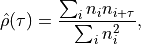
averaged across all selected pixels. The returned ACF is truncated at the first lag at which it falls within the white-noise band
 , where
  is the number
of channels per spectrum.
is the number
of channels per spectrum. acf[0]is always 1.Note that with
threshold = 2a fraction of true noise-only sightlines will be rejected (the maximum ofN_chanGaussian draws routinely exceeds 2 sigma), so the selection is conservative: it favours including only clearly off-source pixels at the cost of sample size, which is fine for a first-order ACF estimate.- Parameters:
data (ndarray) – 3D data cube with the spectral axis first.
N (Optional[int]) – Number of channels at each end of the cube used to estimate
rmswhen one is not supplied. Defaults to5.max_lag (Optional[int]) – Hard cap on the maximum lag returned. If
None, defaults toN_chan - 1.rms (Optional[float]) – Per-channel RMS used to define the off-source threshold. If
None, estimated viaestimate_RMS().threshold (Optional[float]) – Pixels with peak
|intensity| <
threshold * rms
across all channels are treated as off-source. Defaults to2.0.
- Returns:
- 1D array of normalised ACF values,
acf[0] = 1, length between
1andmax_lag + 1.
- 1D array of normalised ACF values,
- Return type:
ndarray
- bettermoments.collapse_cube.build_spectral_covariance(rms, acf, nchan, eps=1e-06)
Build the Toeplitz spectral noise covariance matrix,

where
 is the normalised autocorrelation function returned by
estimate_spectral_acf()and is the per-channel RMS.
Lags beyond
is the per-channel RMS.
Lags beyond len(acf) - 1are taken to be zero.Truncated empirical ACFs need not yield a positive-definite Toeplitz matrix (the implied spectral density can go negative at high frequency). To guarantee a valid covariance suitable for Cholesky decomposition, the eigenvalues are clipped at a small fraction
epsof the spectral radius before reconstruction.- Parameters:
rms (float) – Per-channel RMS noise.
acf (ndarray) – 1D normalised ACF with
acf[0] = 1.nchan (int) – Number of channels (size of the returned matrix).
eps (Optional[float]) – Eigenvalue floor as a fraction of the largest eigenvalue. Defaults to
1e-6.
- Returns:
(nchan, nchan)symmetric positive-definite covariance.- Return type:
ndarray
Utilities
- bettermoments.methods.check_finite_errors(moments)
Check if the errors are finite, and if not, replace them with nearest-neighbor interpolated values.
- Parameters:
moments (tuple) – Tuple of arrays in
(value, error, value, error, ...)order, as returned by one of thecollapse_*functions.- Returns:
- Same structure as
momentswith any non-finite error values replaced by interpolated finite errors.
- Same structure as
- Return type:
verified_moments (tuple)